
15 Best AEO Tools for Answer Engine Optimization in 2026
The best AEO tools for tracking AI answers, finding the pages AI cites, opening your site to AI crawlers and measuring AI traffic, with features and plan prices for each.


A buyer who types “which payroll app is best for a company of 20 people?” into ChatGPT gets one written answer with a short list of brands. Answer engine optimization, or AEO, is the work of getting your brand into that answer and your pages into its sources.
AEO tools make that work measurable. They ask AI assistants your buyers’ questions on a schedule and record which brands and pages appear. Many also help you improve the result, from checking that AI crawlers can read your site to writing pages that answer questions directly.
The 15 tools below include 13 paid platforms and 2 free tools from Google and Microsoft. Each review covers the main features, pros, cons and pricing.
AEO tools: main points
- Entry prices run from $9.80 to $295 a month. Keyword.com starts at $9.80, Otterly.ai at $29 and Arrowsterr at $39 (plus a Free forever plan). Scrunch starts at $250, and AthenaHQ and Goodie at $295. Profound sells custom Enterprise plans after a free trial.
- The big SEO suites now do AEO too. Semrush’s AI Visibility Toolkit starts at $99 a month, and Ahrefs sells Brand Radar from $199 a month per AI index, with no Ahrefs plan needed.
- Google and Bing now share some AI data for free. Search Console has a Generative AI performance report for AI Overviews and AI Mode impressions, and Bing Webmaster Tools shows how often Copilot cites your pages.
- Tracking is one of five AEO jobs. The others are finding cited sources, writing answer-ready pages, opening your site to AI crawlers and measuring AI visits. Arrowsterr covers all five in one platform.
The best AEO tools, by job:
- Arrowsterr for the full AEO loop, from AI answer tracking to content, site fixes and AI traffic, with an AI agent
- Profound for enterprise brands that want prompt volume data and AI crawler logs
- Peec AI for clean reports with unlimited seats and a choice of models
- AthenaHQ for trying many AI models on a free tier first
- Scrunch for brands that want site audits and a version of their site built for AI agents
- Semrush for teams already on Semrush that want AI data next to their SEO data
- Ahrefs Brand Radar for checking any brand’s AI mentions without setting up prompts first
- SE Ranking for daily AI tracking inside a full SEO suite
- Otterly.ai for small teams that want a low price and a GEO audit of their pages
- Goodie for larger teams that want tracking and optimization tasks in one plan
- Writesonic for content teams that want AI tracking inside an AI writing tool
- Rankscale for tracking a long list of AI engines and paying by credit
- Keyword.com for the lowest paid entry price, with Google rank tracking
- Google Search Console for free AI Overviews and AI Mode impression data
- Bing Webmaster Tools for free Copilot citation data and grounding queries
What is answer engine optimization (AEO)?
Answer engine optimization is the practice of making your brand and pages easy for AI assistants to find and quote. An answer engine is any tool that writes a direct reply to a question. ChatGPT, Gemini, Claude, Perplexity, Microsoft Copilot and Google’s AI Overviews and AI Mode all work this way.
An AEO program usually aims for two results:
- Mentions: the AI names your brand when someone asks about your category.
- Citations: the AI links to one of your pages as a source for its answer.
The term AEO is older than most AI chat apps. It first described work aimed at featured snippets and voice assistants, where one answer is read out or shown at the top. The same idea now applies to AI answers, which is why the name came back.
AEO vs SEO vs GEO
The three terms overlap a lot. AEO and GEO (generative engine optimization) describe almost the same work, and both build on SEO.
| What changes | SEO | AEO | GEO |
|---|---|---|---|
| Main goal | Rank pages in search results | Get named and cited in a direct answer | Get named and cited in answers AI writes |
| Where it shows | Google and Bing results pages | AI assistants, AI Overviews, featured snippets and voice answers | ChatGPT, Gemini, Perplexity, Claude, Copilot and Google’s AI features |
| Main metric | Rankings, clicks and traffic | Mentions, citations and share of voice | Mentions, citations and share of voice |
| Data from the platform | Search Console and Bing Webmaster Tools | Some from Google and Bing, the rest from a tracker | Some from Google and Bing, the rest from a tracker |
Google’s own guidance says the best practices for SEO still apply to its AI features, since they are built on its core ranking systems. Google also says no special schema markup or AI text file is needed to appear in AI Overviews or AI Mode. Other AI assistants run their own searches, often on Bing or their own index, so good SEO helps there too.
For more on the GEO side, see the guide to the best GEO tools.
The five AEO jobs and the AEO tools for each
Most AEO work falls into five jobs. No single free tool covers them all, and most paid tools focus on the first two.
| AEO job | What it answers | Tools in this guide |
|---|---|---|
| 1. Track AI answers | Does AI name us for our buyers’ questions, and who does it name instead? | Arrowsterr, Profound, Peec AI, AthenaHQ, Scrunch, Semrush, Ahrefs Brand Radar, SE Ranking, Otterly.ai, Goodie, Writesonic, Rankscale, Keyword.com |
| 2. Find cited sources | Which pages and sites does AI read before it answers? | Arrowsterr, Profound, Peec AI, AthenaHQ, SE Ranking, Otterly.ai, Bing Webmaster Tools (your own cited pages) |
| 3. Structure content for answers | Which pages are missing, and how should they be written? | Arrowsterr (Topic Bank, briefs and Agentic Writer), Writesonic, Profound (Enterprise) |
| 4. Open your site to AI crawlers | Can AI bots reach and read our pages? | Arrowsterr (Zippie’s site audit), Otterly.ai (GEO Audit), Scrunch (site audits), Rankscale (page audits), Profound (Agent Analytics), Search Console, Bing Webmaster Tools |
| 5. Measure AI referrals | How many visits and leads does AI send us? | Arrowsterr (Traffic and Visitors), Search Console (AI impressions), Bing Webmaster Tools (AI citations) |
Two free checks help with jobs 3 and 4 before you buy anything. The AI crawler checker shows which AI bots your robots.txt allows, and the AI answer-ready checker scores a page on how easy it is for AI to quote.
How we chose the best AEO tools
We compared each tool on the same points in October 2026, using its pricing page, help docs, trial or free plan and demos.
- Answer tracking: The AIs covered on the entry plan, how often prompts run, and access to each AI’s full answer.
- Sources: Whether the tool shows the exact pages AI cites, for you and your competitors.
- Work past tracking: Content help, site and crawler checks, and AI traffic data.
- Plans: Prompts, credits, seats, add-ons and trial terms on each plan.
AI answers change between runs, and two tools can show different results on the same day because they ask from different places and settings. Judge each tool on a trend over a few weeks.
How to choose an AEO tool for your team
- Start with the AIs your buyers use: ChatGPT has the largest audience. Google AI Overviews and AI Mode matter if Google sends you traffic. Check the entry plan, since Scrunch Core leaves out Gemini and Writesonic’s plans below Enterprise cover three AIs.
- Check the prompt limit: Plans set how many prompts you can track. Semrush’s AI Visibility Toolkit includes 25, and Arrowsterr Starter includes 50.
- Check how credits work: AthenaHQ, Rankscale, Keyword.com and Ahrefs custom prompts charge by the answer, and premium models use more. Claude uses 5 credits an answer on AthenaHQ and 8 checks on Ahrefs.
- Look for source data: A visibility score shows where you stand, and a list of cited pages shows where to act, such as a review site to get listed on or a Reddit thread to join.
- Check the work after tracking: AEO results come from new and better pages and from a site AI crawlers can read. A tool that covers those steps saves moving data between products.
- Check seats and trials: Peec AI, Otterly.ai, AthenaHQ and Goodie include unlimited seats. SE Ranking, Keyword.com and Arrowsterr have trials with no credit card.
The 15 best AEO tools compared
| Tool | Starts at | AIs tracked | Best for |
|---|---|---|---|
| Arrowsterr |
Free, then $39/mo | 6 AIs | Teams that want the full AEO loop: tracking, content, site fixes and AI traffic |
| Custom (free trial) | 3 AIs on the trial, up to 9 | Enterprise brands that want prompt volume and AI crawler data | |
 Peec AI |
$95/mo | 3 models | Teams that want clean reports and unlimited seats |
| Free, then $295/mo | 11 AIs | Teams testing many AI models on a free tier | |
| $250/mo | 4 AIs (9 on Enterprise) | Teams that want site audits and a site version for AI agents | |
| $99/mo | ChatGPT, AI Overviews, AI Mode and Gemini | Teams already using Semrush | |
| $199/mo per AI index | 6 platforms, plus Claude in custom prompts | Teams checking any brand’s AI mentions without setting up prompts | |
| $129/mo | 5 AIs | SEO teams that want AI tracking inside a suite | |
| $29/mo | 4 AIs | Small teams that want a GEO audit | |
| $295/mo | 5 models (8 on Pro) | Larger teams that want tracking plus optimization tasks | |
| $99/mo | 3 AIs | Content teams that want tracking in an AI writer | |
| $99/mo (Pro) | 17+ engines, by credit | Teams that want to pay by credit across many engines | |
| $9.80/mo | 5 chat apps, plus API models | Teams that want the lowest paid price, plus Google rank tracking | |
| Free | AI Overviews and AI Mode impressions | Teams already on Search Console that want free AI impression data | |
| Free | Copilot and Bing AI citations | Teams already on Bing Webmaster Tools that want free Copilot citation data |
Arrowsterr$39/moPeec AI$95/moThe 15 best AEO tools in 2026
1. Arrowsterr
Arrowsterr is an agentic SEO and GEO platform that covers all five AEO jobs in one place: answers, sources, content, crawler access and AI traffic. It fits teams and agencies that want tracking plus the content, site fixes and traffic reporting that follow. Its AI agent, Zippie, fixes site issues that block AI crawlers after you approve.
Try Arrowsterr free to see which AI answers name your brand.
 ChatGPT64%
 Claude48%
 Gemini71%Best review software for small cafesRevora citedTop guest feedback tools for hotelsRevora cited
The best review software for cafes in 2026
Small cafes live and die by their reviews. One bad week on Google can cost you regulars, and most owners have no time to answer every comment. Review software pulls every review into one inbox and drafts the replies for you.
What to look for
- Written in your brand voice
- Claim check passed
- 6 stats, each with its source
- 4 screenshots placed
Key features
- AI Visibility: From your URL it suggests 5 topics with 5 prompts each and the competitors to watch, then tracks visibility, position, sentiment and share of voice with each AI’s full answer. ChatGPT, Gemini, Google AI Overviews and AI Mode run daily, and Claude and Perplexity run weekly.
- Sources: Groups the pages AI cites by type, such as Reddit, review sites and editorial, so you can see where to get mentioned.
- Social listening: A Social tab finds posts about you and your top competitors on Reddit, X, LinkedIn, YouTube and other sites once a day. It flags “Threads AI cites,” the posts whose page is also a source in your AI answers, and drafts a reply in your brand voice for you to post yourself.
- Agentic Content: The Topic Bank lists the keywords most likely to bring revenue, briefs come from Google’s top 10, and the Agentic Writer (Pro) drafts pages in your brand voice and publishes to WordPress, Webflow, Shopify, HubSpot or Ghost.
- Zippie, the AI agent: Audits your site for issues like missing meta descriptions, missing alt text and robots.txt rules that block AI crawlers, then applies fixes to WordPress or Ghost after you approve, and every change can be undone.
- Traffic and MCP: One line of code shows exact visits from ChatGPT, Perplexity, Gemini and other AI assistants, with each visitor’s journey and a 0 to 100 buyer score. The MCP server lets you ask Claude or ChatGPT about your numbers.
Pros
- Full AEO loop: It’s the only tool here that covers all five AEO jobs in one login.
- 6 AIs on Starter: The $39 plan tracks 6 AIs with no model add-ons.
- Free forever plan: You can check 10 prompts weekly on ChatGPT and Google AI Overviews with no credit card.
- Full trial: A free 7 day trial opens both toolsets, with no credit card.
Cons
- Weekly checks on two AIs: Claude and Perplexity run weekly by default, and Copilot isn’t tracked.
- One toolset on Starter: Starter opens one toolset (AI Visibility or Organic Research), so content and tracking together need Pro at $179 a month.
- Daily social listening: Social listening finds posts through search once a day and has no alerts yet.
Price and plans
You can use Arrowsterr free forever. Plans are as follows.
- Free: $0 forever for 10 prompts checked weekly on ChatGPT and Google AI Overviews, plus 200 research tasks a month.
- Starter: $39 per month ($33 billed yearly) for one toolset (50 prompts checked daily or 3,000 research tasks), 3 brands and 2 seats.
- Pro: $179 per month ($152 billed yearly) for both toolsets, 150 prompts, 8,000 tasks, 10 brands, 5 seats and the Agentic Writer.
- Agency: $499 per month ($424 billed yearly) for 400 prompts, unlimited brands, 15 seats and white label reports.
- Enterprise: from $1,500 per month for 1,000 prompts, unlimited seats and SSO.
Try Arrowsterr free to track your brand on 6 AIs.
 2. Profound
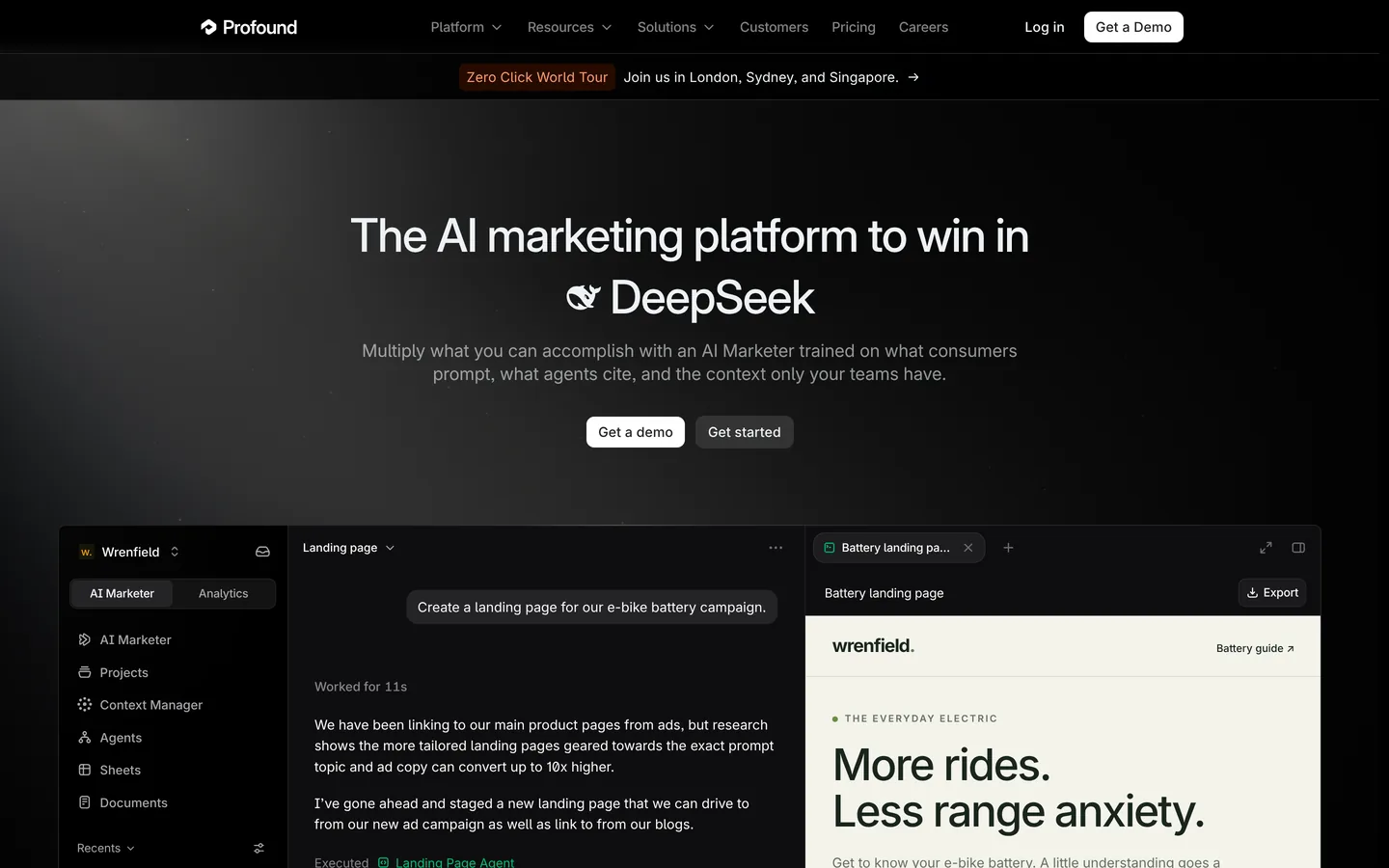
Profound is an enterprise AEO platform with demand data and AI crawler logs. It covers answers, sources, content (on Enterprise) and crawler visits. It fits enterprise brands that want prompt volume and AI crawler data, with a team and budget for a custom contract.
Key features
- Prompt Volumes: Estimates how often people ask AI about a topic, sorted by intent.
- Agent Analytics: Reads AI crawler visits from server logs on hosts such as Cloudflare and Vercel, with no JavaScript tag.
- Up to 9 AI engines: Enterprise adds Perplexity, AI Mode, Claude and Copilot to the trial’s ChatGPT, Gemini and Google AI Overviews.
- AI content generation: Comes with Enterprise.
Pros
- Crawler logs: You can see whether AI bots reached a new page.
- Demand data: Prompt Volumes help you pick which questions to target first.
Cons
- Enterprise plans: Paid plans are custom Enterprise contracts set up with sales.
- Fixed trial prompts: Trial prompts are preset for your industry and can’t be edited.
Price and plans
You can try Profound free for 7 days, with 50 preset prompts run daily on ChatGPT, Gemini and Google AI Overviews. After the trial, pricing is custom.
- Enterprise: custom pricing, with up to 9 AI engines and unlimited seats.
3. Peec AI
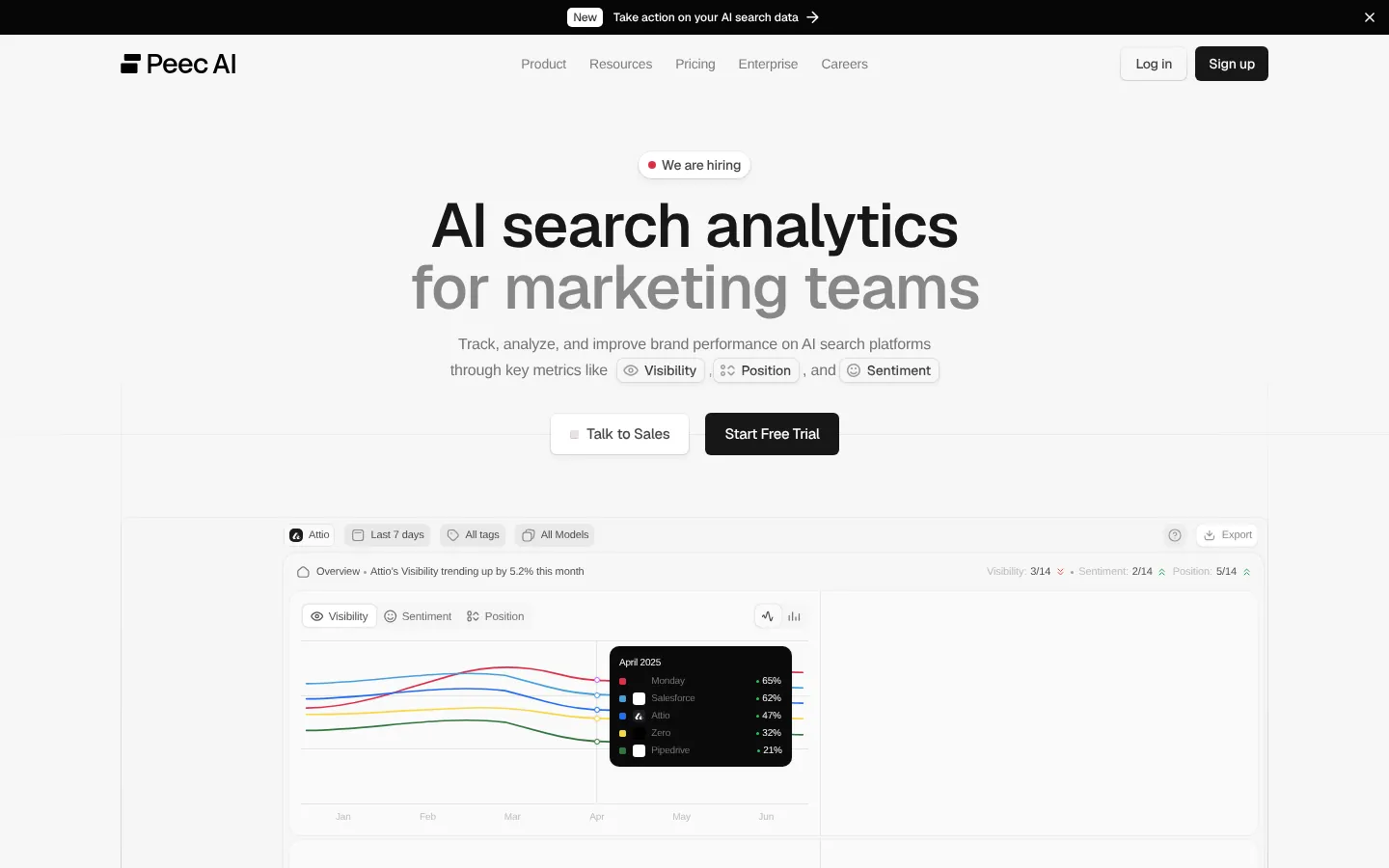
Peec AI is an AI tracker from Berlin known for tidy reports and a simple setup. It covers answers and sources, plus a ranked list of actions. It fits in house teams and agencies that share reports widely.
Key features
- Model picker: On Starter you choose 3 models from a list that includes ChatGPT, Google AI Overviews, AI Mode, Gemini and Copilot, and your prompts run daily.
- Sources breakdown: Shows which sites each AI leans on for your prompts.
- Actions: Turns the data into a ranked list of tasks.
- Exports: You get CSV and an MCP server, plus Looker Studio on Advanced.
Pros
- Unlimited seats: Every plan lets your whole team in.
- Prompt suggestions: Setup suggests prompts for you to track.
- Clean reports: The tidy reports are easy to share across a team.
Cons
- Paid model add-ons: Each extra model costs $35 to $165 a month by plan, and Claude is only on Enterprise.
- One country on Starter: Starter covers one country per project.
- Tracking focus: Content and site tools aren’t part of the plans.
Price and plans
You can start Peec AI with a free trial. Plans are as follows.
- Starter: $95 per month for 50 prompts.
- Pro: $245 per month for 150 prompts.
- Advanced: $495 per month for 350 prompts.
- Enterprise: custom.
 4. AthenaHQ
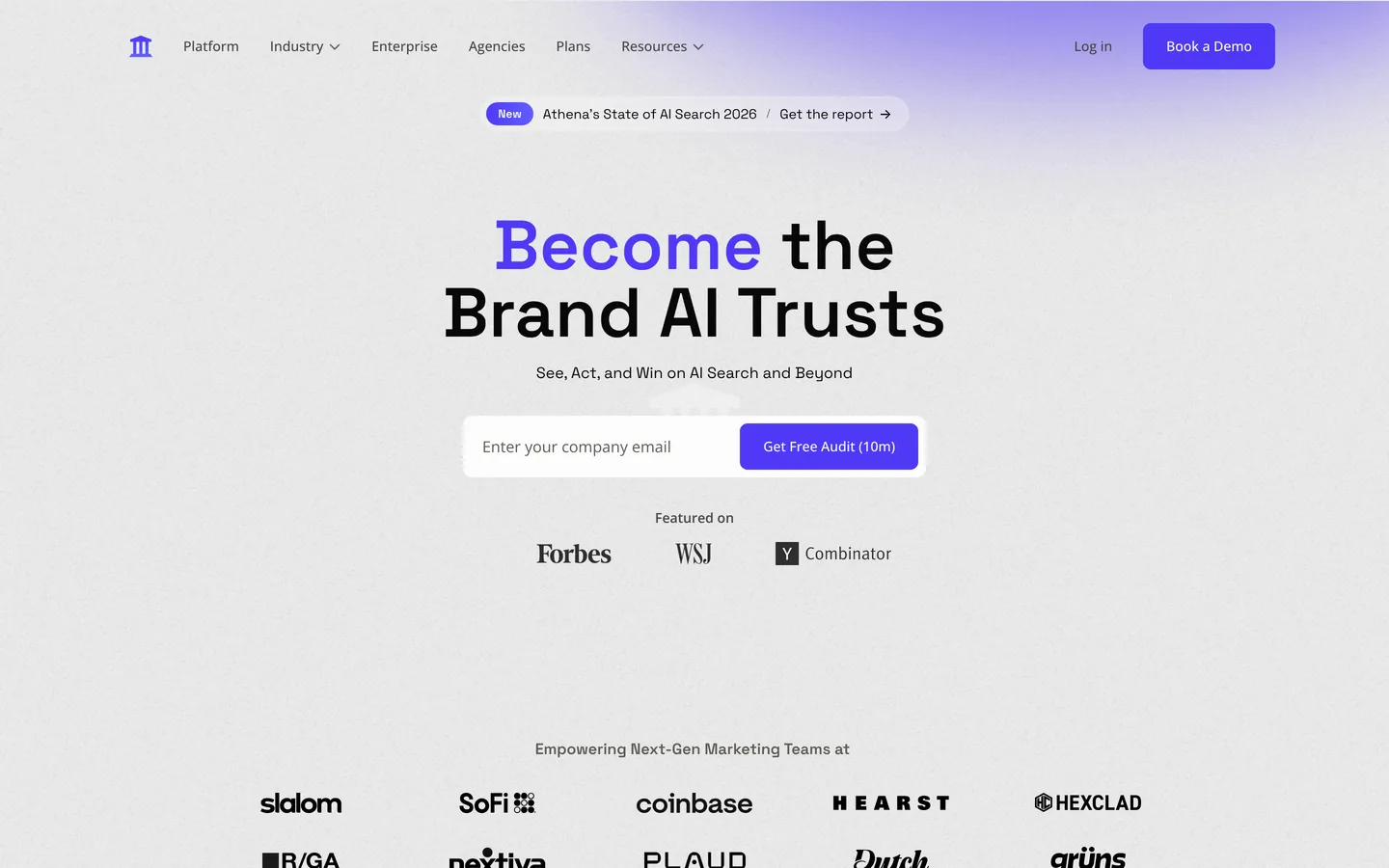
AthenaHQ sells credits that buy AI answers across a long list of models. It covers answers and competitor citations, plus a list of content tasks. It fits funded brands that want answers from many AI models in one place.
Key features
- 11 models on Starter: These include ChatGPT, AI Mode, Claude and Grok.
- Credits: One credit buys one answer on most models, and Starter gives you 3,600 credits a month.
- Competitor citations: Shows, prompt by prompt, which competitors earn citations where you don’t.
- Action Center: Lists content to create or update.
Pros
- Free tier: You can try many AI models before you pay.
- Unlimited seats: Your whole team can use one account.
Cons
- First paid plan: Starter, at $295 a month, is the first plan after the free tier.
- Premium models use more credits: Claude, Grok, DeepSeek, Meta AI and Mistral cost 5 credits an answer.
- One region on Starter: Starter covers one region and language.
Price and plans
You can use AthenaHQ’s free plan (Essential), which comes with 300 credits. Paid plans are as follows.
- Starter: $295 per month ($245 billed yearly) for 3,600 credits a month.
- Enterprise: custom.
 5. Scrunch
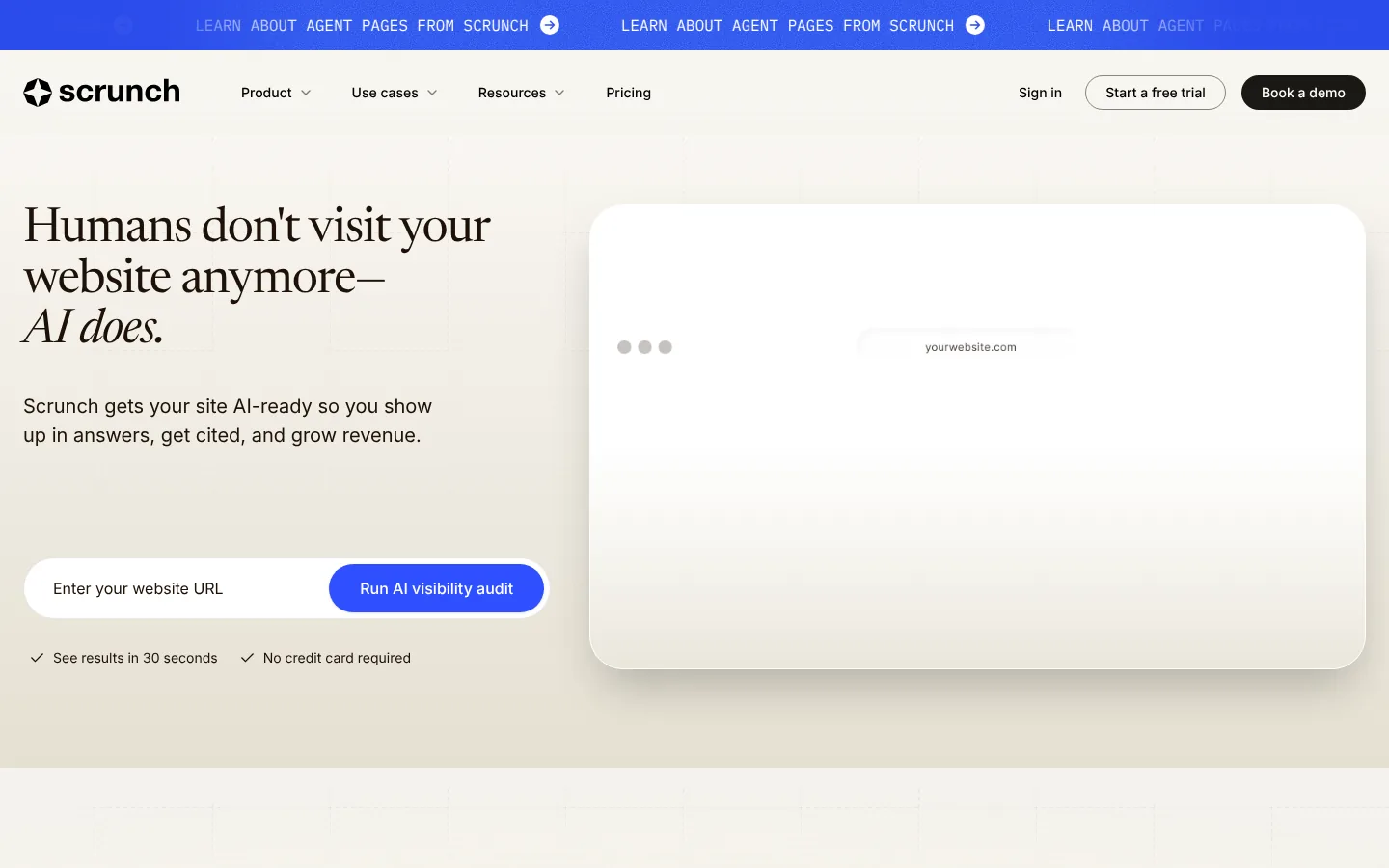
Scrunch tracks AI answers and can serve AI agents a version of your site made for them. It covers answers and crawler access, through site audits and its Agent Experience Platform. It fits midsize brands that want tracking and AI crawler work in one tool.
Key features
- AI tracking: Core covers ChatGPT, Perplexity, Google AI Overviews and Microsoft Copilot, with 125 prompts and 5,000 responses a month.
- Site audits: Core includes 5 a month.
- Agent Experience Platform (AXP): Detects when an AI bot visits your site and serves it a version of the page built for AI to read.
- Enterprise: Adds Gemini, Claude, AI Mode, Grok and Meta AI for 9 platforms, plus API access and SSO.
Pros
- Many prompts: 125 prompts on the entry plan is more than most tools here.
- Crawler work: Site audits and AXP go further on crawler access than most trackers.
- Free trial: You can start a Core trial on your own.
Cons
- Google models on Enterprise: Gemini and Google AI Mode come with Enterprise.
- Entry price: Core starts at $250 a month.
- One brand on Core: Core includes one brand workspace.
Price and plans
You can try Core free for 7 days. Plans are as follows.
- Core: $250 per month for 125 prompts, 5,000 responses a month, 5 site audits and 5 users.
- Enterprise: custom, with 9 AI platforms.
- Agency Core: $500 per month for 250 prompts, 10,000 responses and unlimited users.
- Agency Enterprise: custom.
 6. Semrush (AI Visibility Toolkit and Semrush One)
Semrush is a large SEO suite. It sells AI tracking as its own toolkit, or bundled with its SEO, site audit and content tools as Semrush One. It fits SEO teams that already pay for Semrush.
Key features
- AI visibility reports: Run for any domain, with mentions from ChatGPT, Google AI Overviews, AI Mode and Gemini. Perplexity shows only in Brand Performance.
- Prompt tracking: 25 custom prompts on the toolkit, checked daily, and 50 or 100 on Semrush One Starter and Pro+.
- Brand Performance: An analysis of how AI describes your brand, for 1 domain on the base plan.
- Semrush One: Adds the SEO Toolkit, with keyword tracking, plus API access on Advanced.
Pros
- SEO data in one place: AI data sits next to Semrush’s keyword and backlink data.
- Any domain: Reports work on any domain, which helps with competitor research.
Cons
- Prompt count: The $99 toolkit tracks 25 prompts, and 50 more cost $60 a month.
- Extra domains: Each extra domain costs $99 a month.
- Large suite: The suite has many tools beyond AEO.
Price and plans
You can try Semrush One free for 7 days. The standalone AI Visibility Toolkit has no trial. Plans are as follows.
- AI Visibility Toolkit: $99 per month for 1 project, 1 Brand Performance domain and 25 prompts.
- Semrush One Starter: $199 per month ($165.17 billed yearly) for 50 prompts and 500 tracked keywords.
- Semrush One Pro+: $299 per month ($248.17 billed yearly) for 100 prompts and 1,500 keywords.
- Semrush One Advanced: custom, with unlimited prompts and API access.
 7. Ahrefs Brand Radar
Ahrefs Brand Radar shows how often AI names any brand, from a large index of prompts Ahrefs already collects. It fits SEO teams that want a fast read on their category without prompt setup. Brand Radar is sold on its own, with an Ahrefs Free account, and Ahrefs plans add SEO and site audit tools.

Key features
- AI indexes: Mentions on AI Overviews, AI Mode, ChatGPT, Perplexity, Gemini and Copilot, sold by platform or as one bundle, with no Ahrefs plan needed.
- Custom prompts: Track your own prompts, where 1 check is 1 prompt on 1 AI in 1 location. Claude is only in custom prompts.
- Ahrefs data: Sits next to Ahrefs’ backlink and keyword data for the same brand.
Pros
- Instant data: Data shows up right away, with no prompt list to build.
- Custom prompts from $50: Custom prompts start at $50 a month for 2,500 checks.
- Any brand: You can check any brand’s AI mentions.
Cons
- Bundle price: All five AI indexes together cost $699 a month.
- Claude uses more checks: Each Claude update uses 8 checks.
- Sampled data: Ahrefs notes the index is a sample of AI answers.
Price and plans
Ahrefs has no free trial. Its free AI Visibility Checker is on the Ahrefs site. Paid plans are as follows.
- Ahrefs Lite: $129 per month with 150 custom prompt checks.
- Ahrefs Standard: $249 per month with 300 checks.
- Ahrefs Advanced: $449 per month with 600 checks.
- Brand Radar AI: $199 per month per AI index, or $699 per month for all of them, with no Ahrefs plan needed.
- Custom prompts: $50 per month for 2,500 checks, $100 for 7,000 or $250 for 25,000 checks.
 8. SE Ranking

SE Ranking is an SEO suite with an AI Results Tracker built in. It covers answers and sources, plus rank tracking and site audits. It fits SEO teams that work in a rank tracker every day and want AI tracking inside an SEO suite.
Key features
- AI Results Tracker: Tracks 5 AI engines, including ChatGPT, Gemini, Google AI Overviews and AI Mode, with a location for each.
- Sources and Competitors tabs: Show the pages each answer draws on and who gets named next to you.
- SEO suite: Core adds 2,000 tracked keywords, site audits and competitor research.
Pros
- Daily tracking: Core checks 25 prompts and 2,000 keywords daily.
- Free trial: You get 14 days to test it with no credit card.
Cons
- No Claude: SE Ranking doesn’t track Claude.
- One seat on Core: Core includes one manager seat, and extra seats start at $16.
Price and plans
You can try SE Ranking free for 14 days, with no credit card. Plans are as follows.
- Core: $129 per month ($103.20 billed yearly) for 25 daily prompts and 2,000 keywords.
- Growth: $279 per month ($223.20 billed yearly) for 25 daily prompts, 5,000 keywords and 3 seats.
- AI Visibility (SE Visible): from $71 per month for 75 prompts.
 9. Otterly.ai
Otterly.ai is an AI tracker with a low entry price and a page audit for AI search. It covers answers and citations, plus a GEO Audit of your pages. It fits small teams and freelancers starting with AEO.

Key features
- Brand reports: Track ChatGPT, Google AI Overviews, Perplexity and Copilot with sentiment, and Lite checks 15 prompts daily on these 4 AIs.
- Citations: Shows the domains and URLs each AI cites.
- GEO Audit: Checks crawler access, content readable without JavaScript, page speed and structured data.
- API, MCP and Looker Studio: Come with Standard and up.
Pros
- Low price: The entry plan costs $29 a month.
- Unlimited team members: Your whole team can join.
- GEO Audit: It’s a good first checklist for crawler access.
Cons
- Small entry plan: Lite covers 15 prompts, and the next plan, Standard, is $189 a month.
- Paid model add-ons: Gemini, AI Mode and Claude are paid add-ons on Lite.
Price and plans
You can start Otterly.ai with a free trial. Paid plans are as follows.
- Lite: $29 per month ($25 billed yearly) for 15 prompts.
- Standard: $189 per month ($160 billed yearly) for 100 prompts.
- Premium: $489 per month ($422 billed yearly) for 400 prompts.
- Add-ons on Lite: Gemini and AI Mode from $9 per month each, and Claude from $29 per month.
 10. Goodie
Goodie is an AEO platform that pairs tracking with a monthly allowance of optimizations. It covers answers and optimization tasks. It fits midsize and larger brands with budget for a full AEO program.

Key features
- Tracking: Core covers 110 prompts across 5 models, and Pro covers 250 across 8 models.
- Optimizations: You get 50 a month on Core and 100 on Pro.
- Agency pitch workspaces: The Growth plan gives agencies 10 workspaces a month for prospects.
Pros
- Flexible billing: You can pay monthly, quarterly or yearly.
- Unlimited seats: Core lets your whole team in.
- Tracking plus tasks: Optimization tasks come with tracking in one plan.
Cons
- Entry price: Core starts at $295 a month.
- Agency client plans: Agencies pay for each won client on a brand plan from $295 a month.
Price and plans
You can try Goodie free for 7 days. Paid plans are as follows.
- Core: $295 per month for 5 models, 110 prompts, 50 optimizations a month and unlimited seats.
- Pro: $999 per month for 8 models, 250 prompts and 100 optimizations a month.
- Growth (agencies): $275 per month for 10 pitch workspaces.
- Enterprise: custom.
 11. Writesonic
Writesonic started as an AI writing tool and now sells GEO plans that track AI answers. It covers answers and content writing. It fits content teams that write a lot and want basic AI tracking next to the writer.

Key features
- AI tracking: Plans below Enterprise cover ChatGPT, Gemini and Google AI Overviews, and Starter tracks 50 prompts daily.
- Growth plan extras: Growth adds sentiment analysis and prompt search volume.
- Content tools: Writesonic also sells AI writing tools, so tracking and writing come from one vendor.
Pros
- Lower entry price: It costs less to start than most AEO tools built around content.
- One vendor: Tracking and AI writing come from the same place.
Cons
- Three AIs below Enterprise: Perplexity, Claude and Copilot need Enterprise.
- Growth extras: Sentiment and prompt volume start on Growth at $499 a month.
Price and plans
You can try the paid plans free, with no credit card. Plans are as follows.
- Starter: $99 per month ($79 billed yearly) for 50 prompts.
- Basic: $249 per month ($199 billed yearly) for 100 prompts and 2 users.
- Growth: $499 per month ($399 billed yearly) for 200 prompts.
- Enterprise: custom, with more AI platforms.
 12. Rankscale
Rankscale is an AI tracker that sells credits and covers a long list of AI engines. It covers answers and page audits. It fits teams that want to test many engines and pay by use.
Key features
- 17+ engines: Every plan tracks ChatGPT, Perplexity, Gemini, Claude, Copilot, Grok, DeepSeek and more.
- Credits: Pro includes 1,200 credits a month.
- Page audits and brand dashboards: Both are on Pro.
- Rollover: Unused credits carry over, up to 2 times the monthly amount on Pro and Pro+ and 3 times on Growth.
Pros
- Every engine on every plan: You can track the full engine list on any plan.
- Credit rollover: Credits that roll over suit uneven workloads.
Cons
- Credit pricing: It takes some work to see what each plan covers.
- REST API on Pro+: The REST API starts on Pro+ at $229 a month.
Price and plans
You can try Pro for free. Plans are as follows.
- Essentials: $17 per month, billed yearly, for 120 credits.
- Pro: $99 per month ($84 billed yearly) for 1,200 credits.
- Pro+: $229 per month ($195 billed yearly) for 3,000 credits, with the REST API.
- Growth: $385 per month ($327 billed yearly) for 5,500 credits and white label dashboards.
- Enterprise: $780 per month ($663 billed yearly) for 12,000 credits.
 13. Keyword.com
Keyword.com is a Google rank tracker that also tracks AI answers on credits. It has the lowest paid price on this list. It fits freelancers and small sites that want a low price and Google rank tracking too.
Key features
- Chat apps: Tracks ChatGPT, Google AI Mode, AI Overviews, Gemini and Copilot, at 0.25 credits a run.
- API models: Tracks Claude, Perplexity, DeepSeek, Mistral and Grok, at 1 credit a run.
- Your own schedule: Each prompt can run from daily to monthly.
- Google rank tracking: You can track Google rankings and AI answers in one tool.
Pros
- Lowest price: It has the lowest paid starting price on this list.
- Long model list: You can track many chat apps and API models.
- Free trial: You get 14 days with no credit card.
Cons
- Small entry plan: The $9.80 plan includes 20 credits a month.
- API models use more credits: API models use 1 credit a run, and chat apps use 0.25.
Price and plans
You can try Keyword.com free for 14 days, with no credit card. Paid plans are as follows.
- AI Visibility: from $9.80 per month ($7.83 billed yearly) for 20 credits a month.
- 360° Visibility: from $33 per month ($26 billed yearly) for Google and AI together, with 1,000 keywords updated weekly and 15 AI credits.
 14. Google Search Console (free)
Google Search Console is Google’s free tool for checking how your site does in Google Search. It’s Google’s main source of site data on AI Overviews and AI Mode. Every site should use it as a free first step.
Key features
- Generative AI performance report: Shows impressions in AI Overviews and AI Mode by page, country and date.
- Performance report: AI feature data also counts in the “Web” search type.
- Indexing checks: A page must be indexed and eligible for a snippet to appear in Google’s AI features.
- Prompt ideas: Long queries phrased as questions in the Performance report make good prompts to track.
Pros
- Free: The data comes straight from Google at no cost.
- First party data: You get impression data for AI Overviews and AI Mode from Google itself.
Cons
- Google only: It covers Google and no other AI.
- No answers: It can’t show the AI answer or which competitors got named.
- Limited rollout: Google started the AI report with a subset of sites, so it may not show on every property yet.
Price and plans
Google Search Console is free.
 15. Bing Webmaster Tools (free)
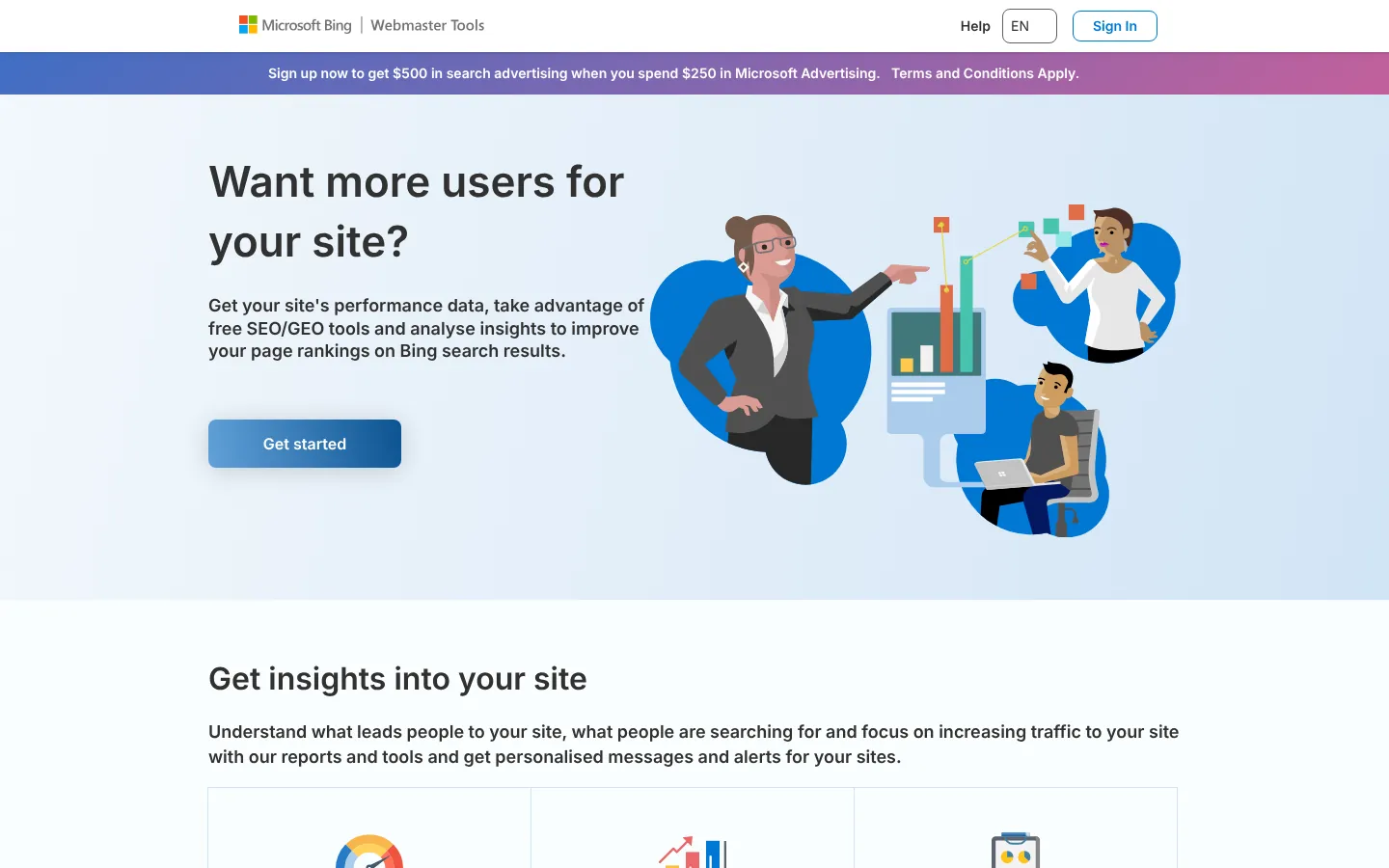
Bing Webmaster Tools is Microsoft’s free tool for Bing indexing. Its AI Performance report shows when Copilot and Bing’s AI summaries cite your pages. It fits anyone who wants to see which of their pages Copilot cites, and for which searches.
Key features
- AI Performance report: Shows total citations, cited pages and the trend over time, in public preview since February 2026.
- Grounding queries: Lists the phrases the AI searched for before it cited your content.
- June 2026 additions: Intents, Topics, Citation Share and Compare, all in preview.
- IndexNow: Tells participating search engines when you add or change a URL.
Pros
- Free Copilot data: You get first party citation data for Copilot at no cost.
- Citation Share: It shows your part of all citations for a grounding query.
Cons
- Sampled data: Bing says the citation data is a sample of overall activity.
- No clicks: There’s no click data for those citations.
Price and plans
Bing Webmaster Tools is free.
AEO tools compared by prompts on the entry plan
Arrowsterr ($39)50Peec AI ($95)50How to do answer engine optimization with an AEO tool
These are the steps from a missing AI mention to a published page in Arrowsterr.
AI visibility this week
ChatGPT64%Claude48%Gemini71%From gap to keyword
Editorial Calendar · buying intent first
Draft ready to publish
The best review software for cafes in 2026
The steps are:
- Find the gap: AI Visibility shows the prompts where competitors get named and you don’t.
- Check the sources: Sources lists the pages AI read for those prompts, so you know which sites to get on.
- Pick the topics: The Topic Bank puts the keywords most likely to bring revenue first.
- Brief and draft: A brief from Google’s top 10 goes to the Agentic Writer, which drafts the page in your brand voice.
- Publish and fix: Send the page to WordPress, Webflow, Shopify, HubSpot or Ghost, and let Zippie fix crawler blocks after you approve.
- Measure: Track visits from ChatGPT, Perplexity and Gemini, and watch your visibility for that topic.
The tips below work with any AEO tool.
Start each section with a direct answer
AI assistants pull short passages that answer a question. Start each section with a one or two sentence answer, then add detail. Use the question as the heading, such as “How much does payroll software cost?”
Add specific facts that AI answers can quote
Prices, plan limits, numbers, dates and named customers are easy for AI to quote. Vague phrases like “best-in-class” give it nothing specific to repeat. Keep your pricing and feature pages current and plain.
Check robots.txt and AI crawler access
Look at your robots.txt for the AI bots that fetch pages for answers, such as OAI-SearchBot for ChatGPT search and PerplexityBot for Perplexity. GPTBot and Google-Extended relate to model training. Google says Google-Extended doesn’t affect how a site shows in Search. Also make sure your main content loads without JavaScript, since many AI crawlers don’t run it.
Get mentioned on the sites AI cites
Your tool’s source report shows the review sites, forums and “best of” lists AI cites for your category. A listing on G2 or Capterra, a helpful reply in a Reddit thread, or a correction sent to a list’s author often moves AI answers sooner than a new blog post.
Track AEO results for two to four weeks
AI answers shift from day to day. Track 25 to 50 prompts across about 5 topics, make one change at a time, and check each topic’s trend after two to four weeks. For a closer look at ChatGPT alone, see the guide to the best ChatGPT rank trackers.
AEO tools FAQ
What is the difference between AEO and GEO?
In practice, there is very little difference. Both aim to get a brand named and cited in AI answers. AEO is the older term and also covers featured snippets and voice answers, while GEO is used mostly for AI chat apps.
Does AEO replace SEO?
No, AEO builds on SEO. Google says its AI features are built on its core ranking systems, so SEO best practices still apply. AEO adds tracking of AI answers, outreach to the sites AI cites and pages written to be quoted.
Do you need schema markup or an llms.txt file for AEO?
Google says neither is required to appear in AI Overviews or AI Mode, and that Google Search doesn’t use llms.txt. Structured data still helps with rich results in regular search, and some other AI services may read llms.txt.
Can you do AEO for free?
You can start free. Search Console shows AI Overviews and AI Mode impressions, Bing Webmaster Tools shows Copilot citations, and Arrowsterr’s Free plan and AthenaHQ’s free tier track a small set of prompts. For daily tracking across several AIs, you’ll need a paid plan.
How long does AEO take to work?
A new mention on a site AI already cites can show up within weeks. Bigger changes, like a new page earning citations, often take one to three months. Give each change at least a month before you judge it.
Summary: best AEO tools
AEO covers five jobs: tracking the answers, finding the sources, writing pages AI can quote, opening your site to AI crawlers and measuring the visits. Most AEO tools on this list cover answer tracking, and some also show sources.
SEO teams already on Semrush, Ahrefs or SE Ranking can add AI tracking to the suite they know, and enterprise brands with a GEO team often look at Profound or Scrunch. Arrowsterr covers every job in one platform, with an AI agent that applies fixes after you approve them.
To see what AI says about your brand today, run a free AI Snapshot. It shows what ChatGPT and Google’s AI say about your brand in about a minute.
The Arrowsterr team
We build Arrowsterr and spend our days helping brands show up in ChatGPT, Gemini, Perplexity and Google's AI answers. We sign up for every tool we review and check every price on the vendor's own site.

Surfer SEO vs Semrush: Content Tools, AI Tracking and Pricing (2026)
Surfer SEO vs Semrush in 2026: content editor, keyword research, backlinks, rank tracking, AI visibility tracking and prices, checked on each vendor's…

Mangools vs Semrush: Features, AI Tracking and Pricing Compared (2026)
Mangools vs Semrush: compare keyword research, backlinks, rank tracking, site audits, AI search tracking and list prices, checked on both vendors' own…

SE Ranking vs Semrush: Pricing and Features Compared (2026)
SE Ranking vs Semrush in 2026: plan prices, tracked keywords, keyword and backlink data, site audits and AI search tracking, checked on…